


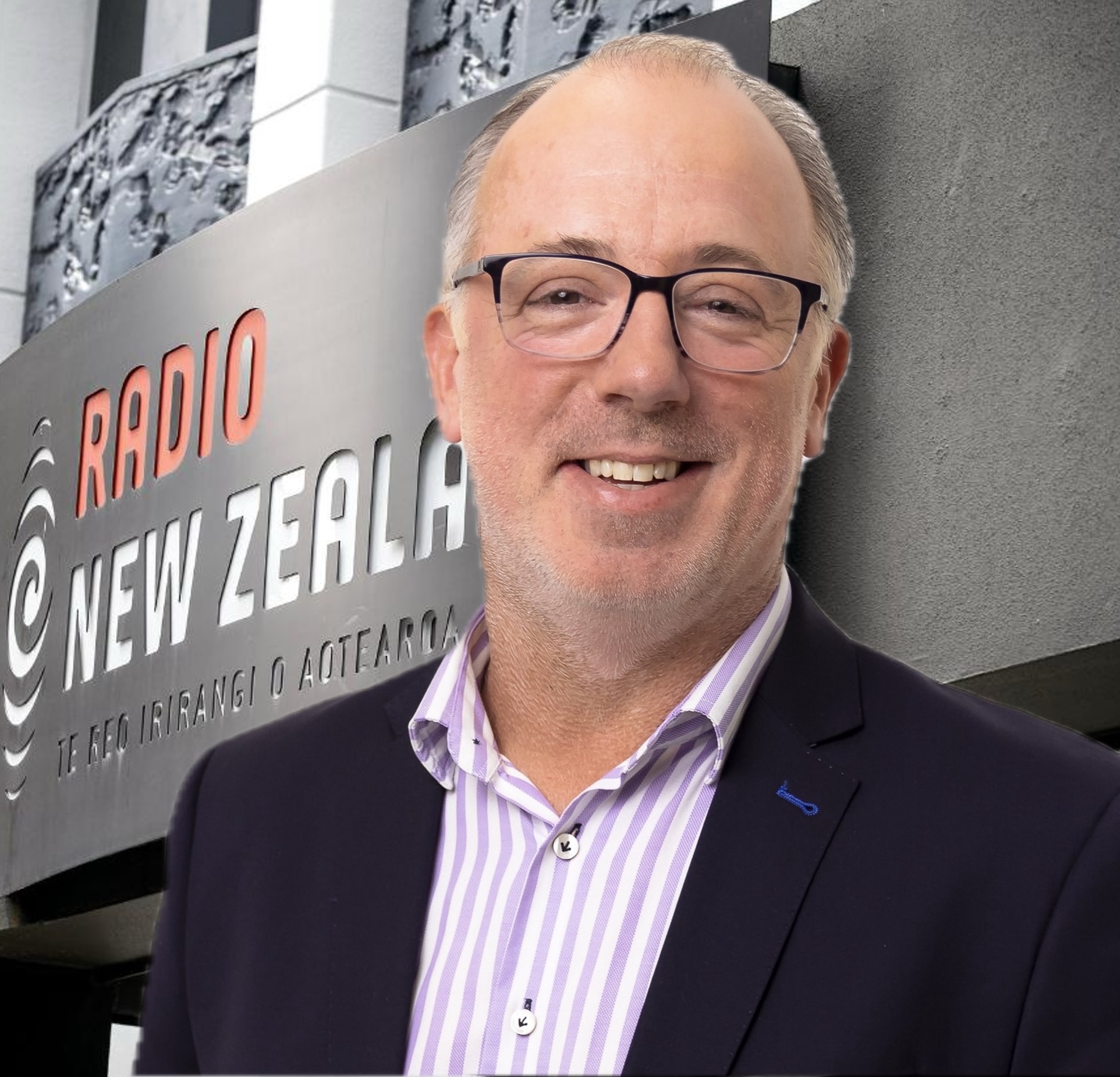
It is as inevitable as death and taxes that Jason Winstanley will change Radio New Zealand, but don’t start pasting the NewstalkZB logo on top of the RNZ tohu just yet.
The outcome of the forthcoming election will play a huge part in determining the mark that the veteran commercial broadcaster will put on RNZ as its new chief executive and, in any event, he will not be there to create NewstalkZB2. You don’t compete by being the same.
Winstanley, currently chief audio officer at NZME and due to take up his new role next year, will have had his eyes wide open when he accepted the new role. He would have known full well that the letter of expectation to RNZ from the incoming minister will be written in ink that is no longer simply blue or red but a weird colour the likes of which we may not yet have seen.
Speculation of change started the moment Winstanley’s appointment was announced. His strongly commercial broadcasting background – plus the reasonable belief that his appointment had been strongly endorsed by the equally-commercial RNZ chair Brent Impey – predictably led to images of a wolfish NewstalkZB poorly disguised with a public broadcasting sheepskin thrown over its microphone.
Had Radio New Zealand been just another private sector competitor, that would have been a natural – if illogical – assumption, but RNZ is no ordinary broadcaster. It is bound by an Act of Parliament, a charter, and a letter of expectation from the minister that holds its purse strings. Change is possible – and I would go so far as saying it is necessary – but it must be consistent with those three documents.
Under the Radio New Zealand Act, RNZ must give effect to its charter. The charter can only be reviewed at five-year intervals. The Act embodies the current version of the charter, which sets out the purpose of a public service broadcaster and how it will deliver on that purpose. The Act goes on to state unequivocally that its services must be commercial-free.
Each year the shareholding minister sends a letter of expectation to RNZ and it is the RNZ board’s responsibility to ensure these expectations are met. Current minister Paul Goldsmith’s latest letter of expectation requires a plan for cost savings, reduced overheads and improved financial performance (living within its means). He also wanted to see better audience figures and higher levels of public trust in the broadcaster. Under the previous Labour-led government the letter of expectation included cooperating in a proposal to merge with Television New Zealand. That plan was later aborted.
Should a National-led coalition return to power in November, we might well see a strong commercial bent emerging from RNZ. That is by no mean certain, however, if a coalition of the left gains power.
And, irrespective of the colours of the rainbow on the Treasury benches, no significant changes to the ethos and modus operandi of RNZ could take place without a fundamental rewrite of the charter and the Act that embodies it. The charter is, however, due for review next year.
There is a lot that Jason Winstanley could do within the current charter and with the backing of a board that has been seeded with commercial broadcasting experience by Goldsmith. He could, for example, make format and personnel changes to increase audience numbers and he may have one or two corporate tricks that could draw a few more fumes from RNZ’s already wrung-out oily rag.
However, a commercially oriented board notwithstanding, he would have limits imposed by the charter that prevented him from a wholesale move to mimic commercial broadcasters in everything bar the advertising breaks. Those limits are imposed by what RNZ is supposed to delivery and how it does so. And a charter requirement to “take account of services provided by other broadcasters” suggests it should try to complement what others do, not go head-to-head in a like-meets-like contest.
Everything in Jason Winstanley’s background suggests he is no fool. He has been with NZME for more than 25 years and has overseen some of its best hires and achievements. On his watch, NewstalkZB has cemented its premier position in the radio market.
He is smart enough to avoid going down rabbit holes. I can’t imagine him saying: “If Luxon is prime minister in a coalition of parties A, B, C and D, I will do X. If Hipkins is prime minister in a coalition of P,Q,R and S, I will do Y. If Wily Fox Peters winds up leading a Coalition of the Unwilling, I’ll do Z”. And he will not try to juggle conflicting manifesto promises on media policy. In any case, they are thin on the ground.
He will await the election outcome and go to Radio New Zealand with Plan A, Plan B and probably Plan C in his pocket.
Plan A will be to ignore the grammatical inconsistency and make the status quo better. In other word, he will have a strategy to extract improvements while working within the current constraints of the Act.
Format and personnel changes are always possible. I yearn for the day, for example, when Morning Report moves from the giggly, chitty-chatty, banter around the studio’s breakfast table to the businesslike presentation of information that bring me up to date and prepare me for the day ahead.
He can also change RNZ’s internal ethos. Who is to say that public broadcasters have a monopoly on positive workplace practices? RNZ cost cutting and redundancies – including the inexplicable loss of Susie Ferguson – do not make for happy workplaces. Has Winstanley dealt with morale issues at NZME that have made him well-equipped to handle things better at RNZ?
His role at NZME includes heading digital audio operations. He will be in a good position to advance the online streaming that RNZ must embrace regardless of policy shifts.
In other words, his Plan A would aim to use potential within the existing organisation to produce better and more effective radio and digital services. That does not mean cloning the stations he will have left behind.
Plan B will be change management. He must be prepared to take RNZ in any of several directions, depending on the ideological outlook of RNZ’s political masters. Leaving aside a neoliberal desire to see it in its grave, there is a range of possibilities.
There is nothing immutable about RNZ’s structure and purpose. It was not always the commercial-free public service broadcaster it is today. Prior to the sale of its commercial networks in 1995, it was hybrid that ran both commercial and non-commercial stations, including what is now NewstalkZB.
Under a coalition of the right, it may be required to find ways to generate at least a portion of its own income. That could see it take a leaf out of the book of Australia’s multicultural and multilingual public broadcaster. SBS operates six tv channels, nine radio stations, and a streaming service. About 30 per cent of its revenue comes from advertising, the remainder from federal funding. Such a move would, of course, require a law change but not a change of focus: RNZ already has an eye on ratings. Winstanley, however, is well-versed in how to turn ears into dollars.
Under a coalition of the left, he may be required to resurrect the aborted amalgamation plan and, frankly, I can’t think of anyone better to fight RNZ’s corner to ensure it was not subsumed by TVNZ.
Under a government of whatever hue he will need to guide RNZ through the tortuous seas that surround the inevitable end of terrestrial broadcasting. A digital-only environment will require a fundamental rethink of what RNZ (doubtless renamed) will deliver. Winstanley must already have his thinking cap on.
Plan C will be an exit strategy. If an incoming government sets impossible or illogical goals (and both are possible), it will be in his own best interests to have a way out that does not leave both himself and RNZ high and dry. A departure in the face of impossible odds would send a strong message to the government that it had got things badly wrong. Winstanley is not a quitter – he leaves NZME with NewstalkZB at an all-time high – and if he resigned from his next post it would because the new government was intent on destroying a public asset.
Paul Thompson had no broadcasting background when he took the role of chief executive at RNZ 13 years ago, but he learned quickly. Jason Winstanley’s appointment has been criticised because he is a creature of commercial – not public service – broadcasting. People will be selling him short if they do not him capable of adapting to new conditions. The real unknown is what those conditions will be.