Public media at the mercy of grubby political paws

If John Reith had not been cremated and his ashes scattered in the ruins of a Scottish church, the father of public service broadcasting would be spinning in his grave.

The BBC’s first director-general saw it as a way to support an inclusive, participatory and enlightened democracy. He has since been dismissed by some as a moralistic, authoritarian Scottish Presbyterian but his principles defined public service media and remain at their core today.

Lord Reith’s broadcasting vision was to bring together different classes and regional populations. Its role was to reinforce social integration. That ideal was – and still is – the antithesis of partisanship and socio-economic superiority.

If he were alive today, he would not simply be annoyed. He was annoyed when he saw a BBC announcer kissing a secretary. He would be more than angry. Anger was something he felt when he spoiled a new battle tunic by getting himself shot by a sniper in the First World War. He would be incensed. He would be enraged at the way those who hold the purse strings have politicised the process of public media funding.

A concept that seeks to serve the interests and needs of a nation as a whole finds itself, in the 21st century, at the mercy of political idealogues and elected manipulators. The right-wing members of these groups accuse public media of being left-wing – in spite of little evidence to support the claim. Indeed, organisations that measure bias tend to put public media in the centre zone.

‘Left-wing bias’ is more likely to be code for confirmation bias that requires media to reflect a person’s (or a party’s) view of the world. No doubt it will be applied by some in the reading of this column.

An excellent example of confirmation bias can be found in the title given to a US House of Representatives sub-committee hearing on the Trump Administration’s proposed cuts to public media: “Anti-American Airwaves: Holding the Heads of NPR and PBS Accountable”. Continue reading “Public media at the mercy of grubby political paws”

PM’s disgraced media advisor had an undeniable duty to tell the boss


The actions of Prime Minister’s media advisor Michael Forbes may not have passed the test for criminal charges, but they were more than peccadilloes: They were gross breaches of privacy. Forbes also breached his fundamental professional responsibilities.

He had an inalienable duty to conduct himself in a way that would not potentially damage the standing of the office he served, the reputation of its incumbent, or their ability to continue normal business. If he failed in that duty, he had an undeniable responsibility to inform his superiors of his misconduct.

Creating audio recordings of encounters with sex workers and covertly photographing women in public places and in what appeared to be private places falls squarely into the category of conduct that crossed that line. It was, of course, also completely unacceptable on so many other levels.

Among other things, he laid himself open to sinister possibilities. Tracy Watkins, who edits both The Post and the Sunday Star Times, said in her Sunday editorial that Forbes potentially opened himself to blackmail and manipulation that could have seen sensitive material falling into the wrong hands.

As Watkins said: The security implications had beltway insiders abuzz when the story broke in The Post.

However, let’s stick with professional responsibility.

Forbes’ covert actions may have psychological roots that mean he could not see they were wrong. By his own admission he has since undertaken counselling. However, the laying of a complaint with Police – irrespective of the outcome – triggered an entirely different imperative. Continue reading “PM’s disgraced media advisor had an undeniable duty to tell the boss”

Picture captions: A small start to big problems

I had some sympathy for the New Zealand Herald yesterday when it issued an abject apology on behalf of its sister Sunday publication over a mis-identified image. I’ve been there, and experienced the gutting feeling it leaves.

I have even greater sympathy, of course, for the innocent party who was the victim of the mistake. I won’t repeat the nature of the error because that would be rubbing salt into the wound.

I had hoped my own experience with misidentification would still stand as an object lesson, but I suppose 25 years is a long time for anything to stay lodged in collective memory.

However, it is fresh in mine. It happened when the Weekend Herald ran a front page story about a leader of the Headhunters Gang but carried the wrong picture. The image was of a community worker whose only connection with the gang leader was as a community carer for his mother.

I had been mortified, right from the moment I received a Saturday morning phone call that began with the words “um, we have a problem.” As editor, it was my problem even though the error had not been mine. And, yes, it felt a bit like being in mission control when Apollo 13 reported an oxygen tank explosion.

It was a costly mistake, but I like to think some good came out of it. That is because the man who was incorrectly identified was Ricky Houghton. He would go on to earn nationwide praise and recognition as a rangatira and social advocate who ran a not-for-profit housing service that provided homes for hundreds of Northland families.

The qualities recalled by many at the time of his death in 2022 were also evident in how he handled the situation our mistake had placed him in. He was dignified, fair-minded, and accepted our offer of financial compensation. His attitude made an awful situation a little more bearable. Our paths crossed years after the mistake, and he was gracious when he recalled events.

My misidentification experience was not unique. My predecessor carried the can when a caption writer wrongly identified a woman as the Governor-General’s wife. And, in a mistake with chilling parallels to my Headhunter saga, a colleague’s wrong use of a name turned a fine upstanding member of the judiciary into a minor rip-off merchant.

Yesterday’s apology was a stark reminder that the identification of subjects in images requires not only diligence but processes to check for accuracy. It is not only a reminder for the Herald but for all news media. First, like all unintentional errors, there but for the grace of God go they. Secondly, in an era of fragmented processes across a range of media inputs and outputs, mistakes are easier to make and less likely to undergo rigorous multi-level checking in depleted newsrooms. Too much can go wrong. Continue reading “Picture captions: A small start to big problems”

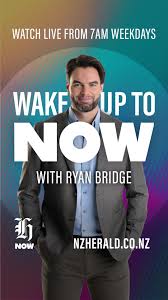
Herald streaming breakfast show’s best ingredient – news

NZME’s new streaming video breakfast show Herald NOW has debuted. And it’s refreshing to see that from start to finish it is about news.

It stands in stark contrast to TVNZ’s Breakfast and its giggly magazine format punctuated by obligatory bulletins and couch-bound conversations.

Ryan Bridge fronts Herald NOW. He is, of course, no stranger to breakfast television, He was a mainstay of TV3’s AM Show before Warner Bros Discovery axed it as a prelude to walking away from news production entirely.

However, the new show is not a remake of AM, in spite of the scheduled reappearances of familiar political panellists David Seymour and Chloe Swarbrick (the former was interviewed on the first show, but his fellow panellist was absent), and Mark Richardson who is swapping sports commentary for financial observations. Richardson’s role – he is now a financial advisor at Forsyth Barr – was previewed last week but the inaugural financial slot on the show was filled by his colleague Zoe Willis. Bridge previewed the lineup in the Weekend Herald.

The new show’s strong news focus was obvious from the outset. It comes from a glassed-off space in the Herald’s Auckland newsroom, with busy journalists all-too-obvious in the background. The set has none of the enforced casualness of couches: It is a radio studio with video cameras. And Ryan Bridge has no coffee-sipping co-hosts with whom he is expected to exchange inane banter to ease you gently into the day. Continue reading “Herald streaming breakfast show’s best ingredient – news”